Discover the beauty of Arouca
Arouca
A true keeper of stories since ancient times, the municipality of Arouca was born and developed, as the people say, in the shadow of its Monastery, especially since the arrival of Queen Santa Mafalda, daughter of King Sancho I and granddaughter of King Afonso Henriques.
A land of fertile and deep valleys, cut by several rivers and embraced by mountains, it settled early on. Fertility and isolation were what those who wanted to dedicate themselves to religion found here. For this reason, Arouca has based a large part of its identity on the Monastery, whose magnificence still dominates the town in which it is located.
The result of various constructions and reconstructions, the current monastery has its roots somewhere in the 10th century, founded by two noblemen from Moldes, Loderigo and Vandilo. In the 12th century, under the guidance of D. Toda Viegas, the Monastery was granted various privileges and donations by D. Afonso Henriques, embodied in the two Charters of Couto, of 1132 and 1143.
At the beginning of the 13th century, already in the possession of the Portuguese Crown, the Monastery was left in a will by D. Sancho I to his daughter D. Mafalda, who arrived in Arouca between 1217 and 1220, after an unconsummated marriage to the King of Castile. She gave herself completely to the monastic life and raised the monastery to a period of absolute splendor.
After D. Mafalda's death, the Monastery of Arouca continued to enjoy enormous prestige, evoking her memory, her protection and cultivating her fame as a saint.
In 1256, after D. Mafalda's death, the monastery continued to enjoy enormous prestige, evoking her memory, her protection and her fame as a saint, which became a cult. Hailed as a saint by the people, she was beatified in 1792 and her body rested in an urn made of ebony, crystal, bronze and silver in a wing of the monastery church, where it was transferred in 1793 (a year after her death).
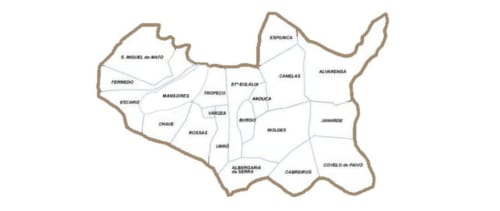
The former couto of Arouca was made up of the territories of most of the parishes that currently make up the municipality of Arouca. They were: S. Bartolomeu de Arouca, Santo Estêvão de Moldes, Cabreiros, Albergaria da Serra, part of the parish of S. Salvador do Burgo, Santa Eulália, S. Miguel de Urrô, Várzea, Rossas, Santa Marinha de Tropêço and Chave. In 1817, the municipality of Vila Meã do Burgo was annexed to that of Arouca. The municipalities of Alvarenga and Fermêdo, after their extinction, also saw their parishes become Arouquenses. Thus, the parishes of Santa Cruz de Alvarenga, Canelas, Janarde and Espiunca became part of Arouca in 1836, and S. Miguel do Mato, Fermêdo, Escariz and Mansores in 1855. In 1917, Covêlo de Paivó, which belonged to the municipality of S. Pedro do Sul, was also annexed, and from then on Arouca had twenty parishes.
A land of fertile and deep valleys, cut by several rivers and embraced by mountains, it settled early on. Fertility and isolation were what those who wanted to dedicate themselves to religion found here. For this reason, Arouca has based a large part of its identity on the Monastery, whose magnificence still dominates the town in which it is located.
The result of various constructions and reconstructions, the current monastery has its roots somewhere in the 10th century, founded by two noblemen from Moldes, Loderigo and Vandilo. In the 12th century, under the guidance of D. Toda Viegas, the Monastery was granted various privileges and donations by D. Afonso Henriques, embodied in the two Charters of Couto, of 1132 and 1143.
At the beginning of the 13th century, already in the possession of the Portuguese Crown, the Monastery was left in a will by D. Sancho I to his daughter D. Mafalda, who arrived in Arouca between 1217 and 1220, after an unconsummated marriage to the King of Castile. She gave herself completely to the monastic life and raised the monastery to a period of absolute splendor.
After D. Mafalda's death, the Monastery of Arouca continued to enjoy enormous prestige, evoking her memory, her protection and cultivating her fame as a saint.
In 1256, after D. Mafalda's death, the monastery continued to enjoy enormous prestige, evoking her memory, her protection and her fame as a saint, which became a cult. Hailed as a saint by the people, she was beatified in 1792 and her body rested in an urn made of ebony, crystal, bronze and silver in a wing of the monastery church, where it was transferred in 1793 (a year after her death).
The former couto of Arouca was made up of the territories of most of the parishes that currently make up the municipality of Arouca. They were: S. Bartolomeu de Arouca, Santo Estêvão de Moldes, Cabreiros, Albergaria da Serra, part of the parish of S. Salvador do Burgo, Santa Eulália, S. Miguel de Urrô, Várzea, Rossas, Santa Marinha de Tropêço and Chave. In 1817, the municipality of Vila Meã do Burgo was annexed to that of Arouca. The municipalities of Alvarenga and Fermêdo, after their extinction, also saw their parishes become Arouquenses. Thus, the parishes of Santa Cruz de Alvarenga, Canelas, Janarde and Espiunca became part of Arouca in 1836, and S. Miguel do Mato, Fermêdo, Escariz and Mansores in 1855. In 1917, Covêlo de Paivó, which belonged to the municipality of S. Pedro do Sul, was also annexed, and from then on Arouca had twenty parishes.
The monastery has therefore always been of fundamental importance, whether in terms of the economy, culture or, of course, religiosity. Benefiting from fertile land such as the Arouca valley, with the River Arda and the protection of the Freita, Gamarão and Mó mountains, the Monastery of Arouca developed until it took on the grandeur we recognize today.
It also played a vital role during the Reconquista, helping to reorganize the territory (both economically and in terms of productivity) and to settle and protect the population (both physically and spiritually).
The history of Arouca is therefore almost the history of its monastery. There, for many centuries, the people of Arouca lived, worked, prayed and built the identity we recognize today.
It also played a vital role during the Reconquista, helping to reorganize the territory (both economically and in terms of productivity) and to settle and protect the population (both physically and spiritually).
The history of Arouca is therefore almost the history of its monastery. There, for many centuries, the people of Arouca lived, worked, prayed and built the identity we recognize today.